

Guides
Helmet manuals and certificates
Ski wax guides 2020
Compression product guides
Help your body recover faster and more comfortably with COMPRESSPORT® technology!
Prevent post-exercise muscle soreness with COMPRESSPORT® products!
To help prevent inflammation and reduce DOMS (delayed onset muscle soreness), you need to “compress” your tired muscles. The effect of compression products is based on improving blood circulation in the muscles through the pressure applied by the garments.
For full-leg compression, we recommend using COMPRESSPORT® Full Legs or, alternatively, a combination of calf sleeves (R2 V2) and thigh sleeves (Quad) during the first two hours after prolonged or exhausting exercise.
For longer recovery periods, the Full Socks RECOVERY compression socks have been designed. The scientifically proven optimal pressure distribution ensures maximum oxygen and energy supply to the leg muscles. These compression socks are also suitable for recovery during long flights, car journeys or train journeys.
Compression products are also available for the arms. COMPRESSPORT® UC Armsleeves combine advanced technical features, high-quality materials, precise detailing and optimised compression. The sleeves are designed for both training and recovery.
Compression socks

RECOVERY compression socks are primarily intended to be worn after physical activity, whether after an intense training session or competition, to accelerate recovery. When wearing the socks, blood circulation in the legs at rest is more than 20% faster than normal, resulting in faster metabolism and removal of waste products from the muscles.
The socks are made from very high-quality materials and feature an anatomical design, excellent fit and comfort. They have 3D technological dots that massage the soles of the feet, stimulate them, provide better foot support and reduce impact.
RECOVERY compression socks are increasingly used during everyday work involving prolonged standing, sitting or fixed postures, as well as during long car or air journeys. A lack of physical activity during travel places continuous pressure on the venous system. The venous valves no longer close properly and blood circulation slows down. The legs become heavy and tired. Compression socks support natural blood circulation, helping blood flow back towards the heart against gravity rather than accumulating in the legs.
When wearing Recovery compression socks:
→ graduated pressure is applied from the bottom upwards – maximum pressure around the ankle is 20 mmHg, gradually decreasing from the ankle towards the knee – pressure at the upper calf is 15 mmHg
→ venous blood circulation improves (+20%)
→ oxygen supply to the leg muscles improves (+15%)
→ metabolism in the leg muscles improves
→ swelling, pain and discomfort are reduced

If your calf circumference and/or foot size falls between two sizes, choose the larger size.
Calf Circumference – circumference of the widest part of the calf. Foot size – shoe size.
How to put on compression socks?
Full leg compression sleeves

Full Leg is a compression product developed in cooperation with Pro-Tour cycling teams. Thanks to especially strong, medically controlled graduated compression, you only need to wear them for a few hours after active training, allowing your legs to recover in record time. The product gives tired leg muscles an immediate feeling of comfort and freshness.
It is used during recovery by runners, triathletes and cyclists because it:
→ improves venous blood circulation (+20% within seconds)
→ prevents blood stagnation
→ provides strong compression along the entire leg
→ helps remove toxins (-13%)
→ reduces inflammation (-50%) and swelling (-100%)
→ helps reduce muscle and joint pain (-50%).

If your measurements fall between two sizes, choose the larger size.
Thigh – thigh, calf – calf
Calf sleeves

R2 V2 calf sleeves are primarily designed for use during exercise, but they can also be used afterwards for recovery (recommended for no more than two hours after exercise).
When wearing R2V2 calf sleeves during recovery:
→ venous blood circulation improves (+20% within seconds)
→ oxygen supply to the leg muscles improves (+25%)
→ swelling, pain and discomfort are reduced because firm compression is applied to the entire calf.

If your calf circumference falls between two sizes, choose the larger size.
Thigh sleeves

COMPRESSPORT Quad V2 thigh compression sleeves can be used during sport as well as after exercise. The seamless thigh sleeves provide 360° compression around the muscles and help the muscles recover faster. They are also comfortable to wear under sports shorts. A silicone band at the top prevents them from slipping down.
When wearing thigh compression sleeves during recovery:
→ venous blood circulation improves (+10%)
→ metabolism in the thigh muscles improves
→ oxygen supply to the thigh muscles improves (+5%)
→ possible post-exercise muscle soreness is reduced (-50%)

If your thigh circumference falls between two sizes, choose the larger size.
Arm sleeves

COMPRESSPORT UC Armsleeve compression sleeves provide greater strength and faster recovery for the arms. The seamless microfibre fabric offers optimal comfort and ergonomics, providing exceptional freedom of movement and a second-skin feel.
The sleeves can be used for recovery after swimming, gym training or any other sport involving significant arm work, because they:
→ improve blood circulation
→ improve oxygen supply to the muscles (+5%)
→ reduce muscle inflammation (-50%)
→ keep the arms feeling light and relaxed.

If your arm measurement falls between two sizes, choose the larger size.
Skateboard manuals
Support and brace manuals
Choosing skis
First of all, you need to determine whether…
…you need skis for a well-prepared, firm ski track or whether most of your skiing will take place in deep, soft snow.
…you are looking for classic or skate skis. Or perhaps you want to alternate between both techniques – that is also possible.
While serious skiers usually have several pairs of skis for different temperatures and both skiing techniques, an average recreational skier can manage well with one or two carefully selected pairs.
As a general rule, classic skis should be 15–20 cm longer than your height, while skate skis should be 5–10 cm longer. If you want to use one pair of skis for both techniques, choose classic skis approximately 10–15 cm longer than your height.
A pair of skis with the correct stiffness (and, in the case of classic skis, the exact grip-wax zone or wax pocket) can be quickly determined using the paper test.
Proceed as follows:
- First, find the ski’s centre of gravity (balance point) and mark it on the side of the ski;
- Place the pair of skis on a flat, hard surface, put a sheet of paper under the middle of the skis and stand on the skis so that your toes are positioned over the balance point;
- While applying different amounts of pressure to the skis, ask another person to move the sheet of paper back and forth.
Use the following table to determine whether the skis are suitable:
| Skiing style | standing on both feet | standing on one foot | standing on the ball of one foot |
|---|---|---|---|
| classic ski* | the paper moves approximately 60 cm forward from the heel. This is the grip-wax zone or wax pocket. | the paper does not move | the paper does not move |
| combi ski or universal ski | the paper moves approximately 60–70 cm | the paper moves slightly only under the foot | the paper does not move |
| skate ski | the paper moves 60–80 cm | the paper moves 30–50 cm | the paper moves only under the foot |
*If in doubt, choose a pair of skis with a slightly softer flex rather than skis that are too stiff. This ensures reliable grip on climbs and when you become tired. Remember that few things can spoil the enjoyment of skiing more than skis that slip backwards during the kick.
Paper test
.
.
.
.
.
.
.
Proceed as follows:
- First, find the ski’s centre of gravity (balance point) and mark it on the side of the ski;
- Place the pair of skis on a flat, hard surface, put a sheet of paper under the middle of the skis and stand on the skis so that your toes are positioned over the balance point;
- While applying different amounts of pressure to the skis, ask another person to move the sheet of paper back and forth.
Use the following table to determine whether the skis are suitable:
| Skiing style | standing on both feet | standing on one foot | standing on the ball of one foot |
|---|---|---|---|
| classic ski* | the paper moves approximately 60 cm forward from the heel. This is the grip-wax zone or wax pocket. | the paper does not move | the paper does not move |
| combi ski or universal ski | the paper moves approximately 60–70 cm | the paper moves slightly only under the foot | the paper does not move |
| skate ski | the paper moves 60–80 cm | the paper moves 30–50 cm | the paper moves only under the foot |
*If in doubt, choose a pair of skis with a slightly softer flex rather than skis that are too stiff. This ensures reliable grip on climbs and when you become tired. Remember that few things can spoil the enjoyment of skiing more than skis that slip backwards during the kick.
.
.
.
Footwear size charts
Alpine Pro

Alpina
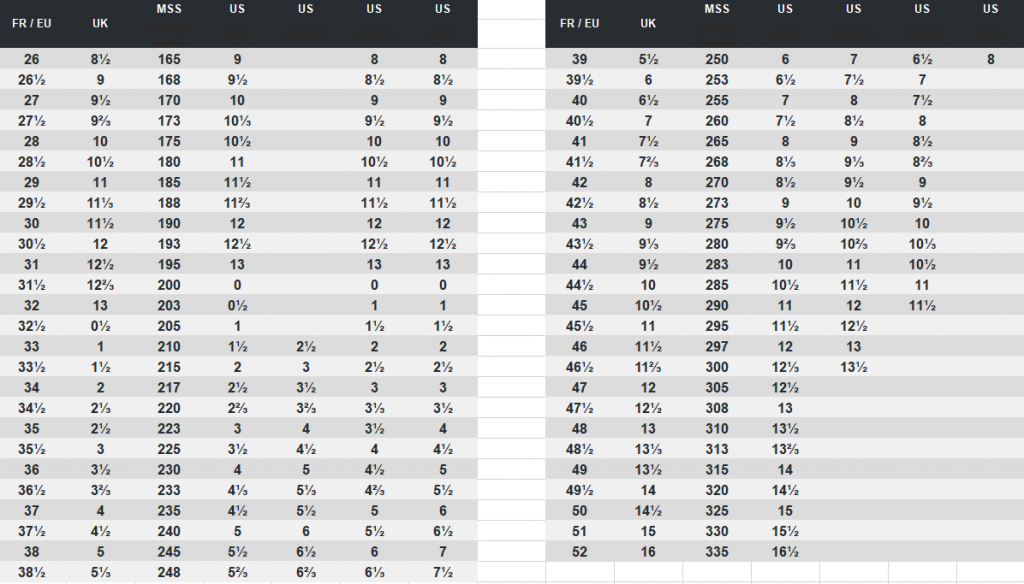
ON running shoes


HOKA running shoes


Clothing size charts
Alpine Pro


Craft


AGU


Compressport socks and calf sleeves


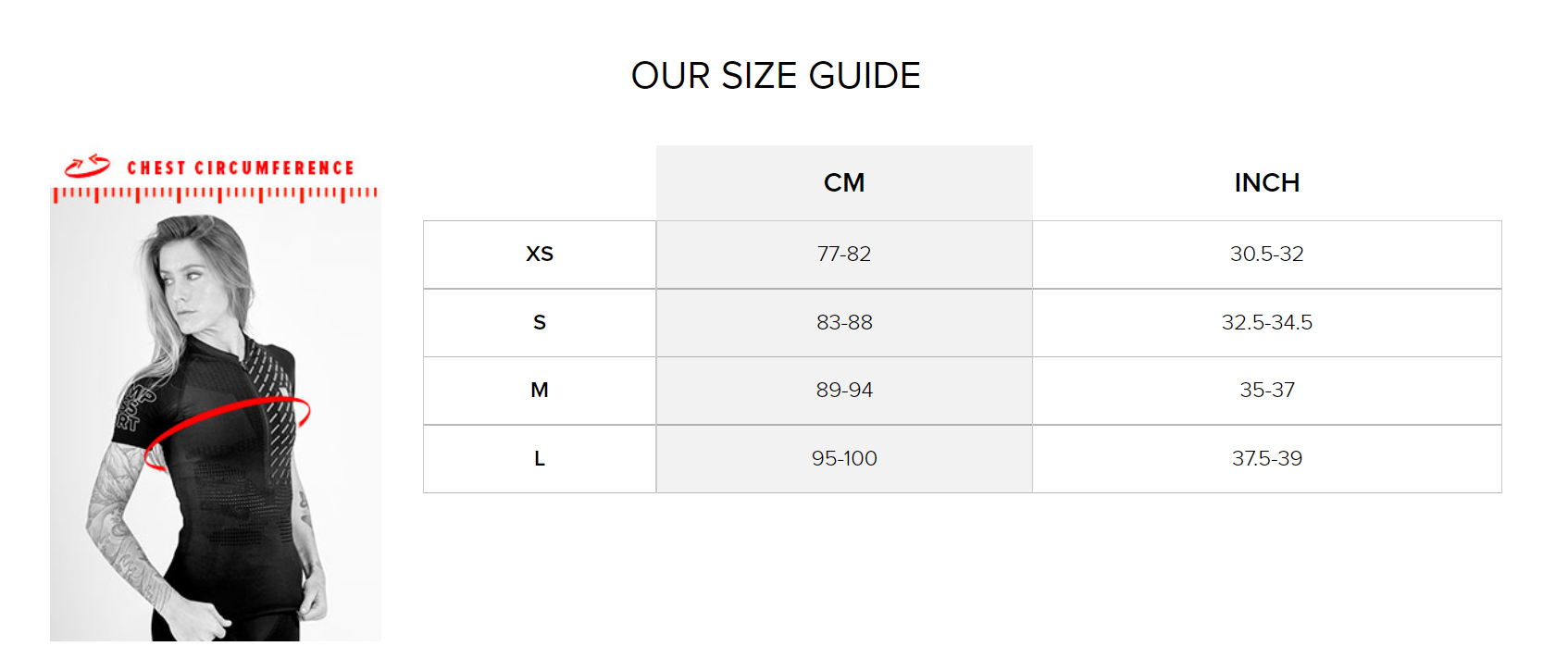
Compressport tops

Compressport trousers

